
What Gun Should I
Buy?
Some Practical Advice for the Novice
Gun Owner
You've Made The Big Decision, Now What?
OK, you're going to buy a gun for personal defense. Having settled the question of whether to own one, now you have to decide what you want. The first-time gun owner is usually bewildered by the seemingly endless variety of firearms available, all of them claiming to be the "best" weapon for personal defense. The gun magazines available in the supermarket don't make things any easier for someone who doesn't have a fairly high level of familiarity with firearms in general.
Certain assumptions are made in this essay. First, that the reader has no specialized knowledge beyond that available in the NRA's Personal Protection Course, and is contemplating a one-time purchase. Second, that the gun you'll buy will serve in and outside your home as a defensive weapon, and isn't intended to be used for hunting or target shooting. Third, that you want to be discreet about going armed, and if you carry your gun on your person, it will be concealed from sight.
While in most states no license is required for open carry (FLORIDA DOES NOT ALLOW), you will certainly cause a ruckus if you strap on a gun and go to your local mall! Outside your home, if you want to avoid problems, it's best to keep a gun out of sight. Even if you are 100% legal, you're surely in for an unhappy half-hour as the center of attention, should someone in a restaurant spot the gun, get hysterical, and call the police. Remember also that it's been said that, "It's a poor cop who can't find something to charge anyone he stops with." A charge of "disturbing the peace" is commonly lodged against people who carry openly, or who inadvertently display their gun in a public place even if they are 100% legal. This is actually police department policy in some jurisdictions!
Be aware that most states do require a special permit for carrying a concealed weapon, and you should consult an attorney about the law on this matter. If you're going to do it, it's best to do it legally and save yourself a lot of trouble.
The Golden Rule
I'm also assuming that if you do carry a gun on a day-to-day basis, it's as a last-ditch, back-to-the-wall, no-other-choice defense. It's much easier to avoid trouble than to get out of it, and using common sense about potentially dangerous situations is the most effective weapon of all. The basic rule is simple: Never do anything while you're armed that you wouldn't do if you weren't.
Decisions, Decisions...
Picking out a gun to carry and use on a day-to-day basis is like picking out a spouse: everyone has different ideas on what they want. But--just as with a spouse--there are some general guidelines on what it's best to avoid and what you should look for.
Do You Really Want a Handgun In The First Place?
While the advice given here relates mainly to handguns as defensive weapons, there are other options. Shotguns and some rifles may be a better choice for some people and some situations. If you have decided you don't want to carry a gun in your car or on your person, or if you are so unfortunate as to live in a jurisdiction in which handguns are difficult or impossible to buy legally, you might as well ignore what I have to say about.
Shotguns and rifles also may be a better choice for the individual who is unwilling or unable to practice enough to feel confident with a handgun. This is not to suggest that practice is not important, but that a shotgun (and to a lesser extent a rifle) is easier to use under stress than a handgun.
Choosing a Defensive Handgun
Let's say that like most people you do expect sooner or later to carry the gun in your car or on your person. A handgun is what you need, and the first decision to make is whether it's to be a revolver or an autoloader. The key to your selection should be a satisfactory compromise among safety, size, power, and price.
A gun that's to be carried concealed can't be too big; one that's to be effective can't be too small. While there's no such thing as a perfect personal defense weapon, there are enough possibilities within these two conflicting requirements that you can come reasonably close.
Regrettably, there is no easy solution to this dilemma. There is no simple formula that can be applied to determine the "best" choice of a handgun; it truly is an individual decision, and anything you select will inevitably be imperfect in some respect. Why? Because really small guns that are easy to conceal are weak killers and require expert skills; while really powerful guns are generally too large to conceal easily and may be difficult to shoot accurately.
With those caveats in mind, let's look at the question in general terms. Be aware that the specific models discussed in this essay are current-production in most cases, and prices quoted are roughly the list price for a new example. They also represent my particularly favored models, and they may not be right for you. Play the field a bit, shoot any model you can find that interests you, and base your decision on your own experience. It's impossible in an essay like this to cover all the thousands of handguns, new and used, that are available on the US market.
New Or Used?
Many now-discontinued models can be found in the used-gun market, as can "pre-owned" examples of those still in production. Buying a used gun requires a certain amount of knowledge and experience, and you'd be well advised to take someone along with you who can give you sound advice on any used gun you might be thinking about. You're much less likely to get burned buying a used gun than a used car, and it can save you a good deal of money.
New guns offer some real advantages. They come with a manufacturer's warranty, and you have recourse if there are problems. This is usually not the case with a used gun. You will know what the gun's history is; you will have proof of legal ownership; and assuming you've done your homework about what you need and want, you don't need to worry about anything except the price you want to pay. To offset these advantages, of course, the new gun will be significantly more expensive than a used one of the same make and model.
Good-quality handguns are expensive. But they have an indefinite working lifetime; it's hard for the average person to even begin to approach the level of shooting activity that will wear one out. There are millions--no, tens of millions--of handguns manufactured 50 or more years ago that are as good as they were the day they left the factory. A gun purchased new usually will have a high resale value, if it's a decent brand. Properly cared for and maintained, a good quality handgun may well be worth more than you paid for it if and when you come to sell it. A Browning High-Power, bought new in 1968, had a list price of about $105.00; today that same gun in excellent condition will fetch $450 or so, possibly more. Even allowing for 30 years of inflation, that is a decent return on your money.
Where Do I Go To Buy Them?
Virtually all-current production guns can be bought for considerably less than manufacturer's list price at a pawn shop. Most pawn shop and gun shops will special-order anything for you at 10-15% over dealer's cost, plus shipping.
Discount stores usually don't carry handguns; Wal-Mart is an exception. They have recently succumbed to the general anti-gun hysteria now prevalent, and no longer have them on display, but can special order almost anything you want, usually at a very favorable price. (It's as well to point out that a discount store isn't really a gun store, and that the level of expertise of the average discount store clerk is well below what you will find in a specialized gun store, as is the after-sale service you can expect. You get what you pay for, as in most things.)
Look, I'm Really New To This Gun Stuff. Where Do I Start?
For a first-time buyer and brand-new shooter a double-action revolver is often the best choice, as they're mechanically simpler to manipulate and slightly safer in unskilled hands than autoloaders. Revolvers are generally (not always) less expensive and generally (not always) less prone to mechanical failure than autoloaders. On the down side, a double-action revolver is much more difficult to shoot accurately than an auto loading pistol of comparable size and power, and requires more practice to gain proficiency. With respect to concealment, the increased width of the revolver may also make it slightly more difficult to conceal and/or less comfortable to wear for extended periods.
The Generic Revolver
A typical double-action revolver, the S&W Model 10, with 4" barrel
Most manufacturers offer a "basic" revolver and fit it with a choice of 2", 3", or 4" barrels. The 2" is the most concealable size, if it's available. A 3" barrel improves velocity somewhat, and a 4" even more; but long-barreled guns are significantly more cumbersome than the shorter ones and harder to conceal. Snubbies harder to shoot accurately at long range, but this isn't a major problem if you are shooting at seven yards or less. If the gun is to be kept in the house and not carried concealed, a 4" barrel is fine, and probably preferable to the snub.
Hey, Didn't You Say Something About Autoloaders?
Auto loading pistols are usually narrower than revolvers of similar power, though they may be longer. They don't have the thick cylinder, and their flatness makes them easy to hide. Good, reliable name-brand autoloaders are generally expensive, but there are exceptions to this statement, particularly if you're buying a used gun. It's much easier to find a good used autoloader than a good used revolver. There are currently large numbers of military-surplus handguns being released into the market (see below). It's also easier to learn how to shoot accurately with an autoloader than it is with a revolver. Years of military and police experience have shown the truth of this statement.
The Generic Autoloader
The Beretta "Cheetah," an exposed-hammer, double-action autoloader in .380 ACP
Barrel lengths of autoloaders range from 3" to 5". A 4" or 4-1/2" barrel is best, but the compactness of most autoloaders makes even a 5" barrel practical, which it wouldn't be in a revolver. The principal drawback to choosing an autoloader is that there are several different styles, all of which have their own operating characteristics.
My Personal Prejudice On The Question of What's Best for a Novice
I'm something of a heretic in this matter of revolvers vs. autoloaders for novices. After considerable experience teaching new shooters I've come to disagree with the conventional wisdom that beginners should stick to revolvers. P> Safety is the most important issue to be addressed when advising new shooters about the choice between the two types of handgun; but it's my contention (and I am not alone in thinking this) that anyone can learn to handle any gun safely. Whatever you choose, if you learn how to use it properly, there's no significant difference between the two in this respect.
From what I have seen, teaching a total novice to handle an autoloader safely really isn't all that much more difficult than it is with a revolver; and indisputably it is much easier to teach new shooters to hit what they are aiming at with an autoloader, all other things being equal. This, of course, is the military's point of view. Since 1911, all US soldiers--most of whom are totally ignorant of firearms when they enlist--have been trained into passable self-defense pistol shots using autoloaders. The same is true of armies all over the world. If millions of GI's can master the auto-loading pistol, anyone else can, too.
I am firmly of the opinion that for women in particular (most of whom have no interest in sport shooting and see a handgun as strictly a personal-defense tool) a medium-sized autoloader in 9mm Parabellum is by far the best route to competence and confidence. A good 9mm autoloader, be it single- or double-action, represents an effective compromise between size, safety, power, and portability for any new shooter, and especially if that shooter is a woman.
I recommend to most people a 9mm autoloader with an exposed hammer. Hammerless designs are usually very easily concealed, but an outside hammer affords a significantly greater degree of handling safety. You can see what condition a gun with an outside hammer is in, which you can't do with the hammerless types.
CALIBER CHOICE
A selection of popular calibers for personal defense
Rule Number 1 of Caliber Selection: Keep It Simple
Practice makes perfect--or at least competent. You should be able to afford to practice, and obtaining ammunition shouldn't be a hassle. Therefore, Rule Number One of ammunition selection: Pick a caliber you can get in discount stores.
What's That Supposed To Mean?
In practical terms, this means a revolver should be either a .38 Special or .357 Magnum; an autoloader either 9mm Parabellum or .45 ACP. These calibers have all been proven effective for personal defense over many years. You can find any of these calibers virtually anywhere ammunition is sold. You can buy relatively inexpensive reloads or military surplus ammunition for practice, and save the expensive stuff for serious use.
That's It? Surely There Are Other Choices!
Yes, indeed. There are lots of calibers that are suitable for a defense handgun, but none of them is so universally available as the ones mentioned above. Now, on to some specifics and why you might choose one over the other:
The Big Bad .357 Magnum
The .357 Magnum is the most powerful of the calibers I've suggested above. It's generally available only in revolvers. It takes a lot of practice to handle a gun chambered for this caliber well, and for novices it's most likely not a good choice. It can be extremely unpleasant to shoot in a short-barreled gun, and anyone whose recoil or noise-sensitive should avoid it. A 2-1/2" barreled .357 has a muzzle flash like the exhaust gas from the Space Shuttle; it's easily bright enough to be seen in daylight. It is also just about the LOUDEST thing you will ever hear.
All Is Not Lost For The .357 Magnum Owner
You don't have to shoot full-power .357 loads, however. Any sort of .38 Special ammunition can be fired in any .357 Magnum revolver, and if you find a .357 that's a good buy, it's well worth serious consideration. You can always use it as a .38 until you get comfortable enough with it to move up to the more powerful caliber. And if you never do move up, you'll still have a serious defense handgun.
The .38 Special was introduced in the 1890's, and went on to become the most popular handgun caliber ever invented. It's available only in revolvers, but every revolver maker has a .38 Special in its product line. It is reasonably powerful, very accurate, and universally available. At one time it was the premier choice of police departments, and more cops carried .38 Specials than anything else, until the wave of re-arming police agencies with autoloaders started about 15-20 years ago. If there is one "do-anything" caliber, this is it.
The 9mm Parabellum
The 9mm Parabellum is the world's most popular pistol round, used by more military forces than any other, including (since 1985) our own Army. It's easy to shoot and easy to train people with. Introduced in 1902 as a military round by the Swiss Army, it has a long-standing and well-deserved reputation as an effective round.
You will not have any trouble finding ammunition for a 9mm. Most of the guns chambered for it are fairly large, but even so, as autoloaders, they can often be carried concealed without too much trouble. Any good 9mm makes a fine house or car gun. The 9mm has the widest range of bullet types and performance levels of any auto loading pistol caliber. There are many fine defensive-type loadings on the market.
While it is primarily thought of as a caliber for autoloaders, there have been several revolvers chambered for it, and it performs well in these, though it hasn't much advantage over the .38 Special.
New Kid On The Block: .40 Smith & Wesson
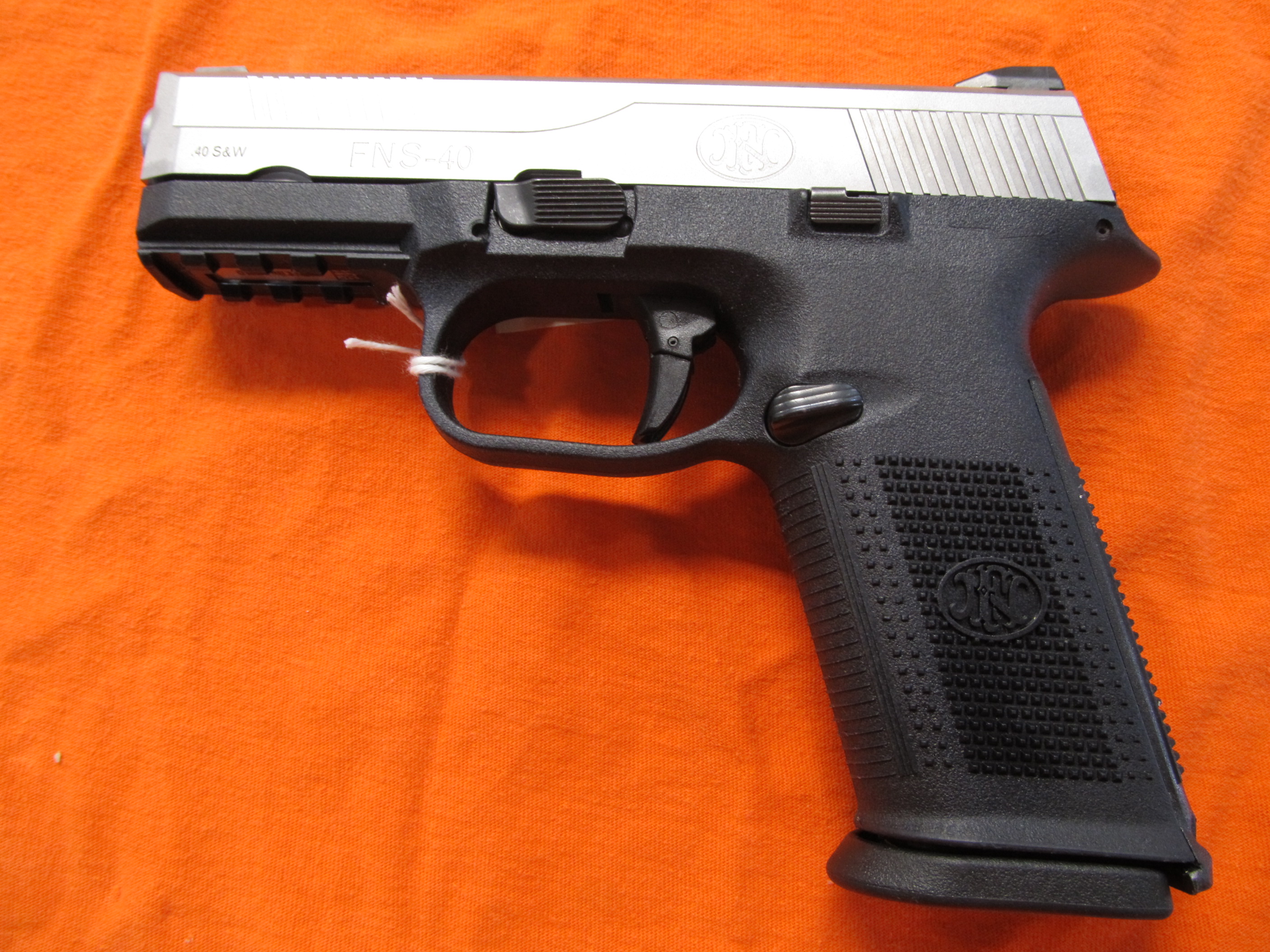
Periodically someone notices that there is a "gap" between the medium-bore 9mm/.38 cartridges and the .45's and they invent a new caliber to fill that gap. These almost always come out as 10mm or .40-caliber rounds. The latest example of this genre is the .40 Smith & Wesson. It is used in a wide variety of high-quality auto loading pistols. The .40 S&W has attained considerably more popularity than nearly any other 10mm or .40 caliber has in the past; much of this is attributable to its adoption by numerous police agencies looking for something with better ballistics than a 9mm, but easier to shoot than a .45 or a .357 Magnum. The .40 S&W is an effective man stopper, based on early data from shootings, and probably will be around a long time. It may be difficult to obtain locally, but most larger gun shops stock it. It's a good choice if you want to move up a step from the medium bores.
The Orphan .44 Special
Another very fine defense caliber, though less readily available than these three, is the .44 Special (not the .44 Magnum). The biggest problem with the .44 Special is finding the ammunition. It's pretty scarce, and you may have to resort to mail order. Another drawback is that there aren't many good self-defense guns chambered for it, though there are some. But if you can get it, it's an excellent revolver cartridge. This round is a holdover from the late 19th Century, and is the direct ancestor of the much more powerful (and common) .44 Magnum. As with the .38 Special/.357 Magnum situation, the .44 Special can be fired in a revolver chambered for .44 Magnum. It's not chambered in autoloaders.
The .44 Special is chambered in some compact and hard-hitting guns not much bigger than the .38's, and considerably more powerful. "Serious" defense loadings in such small guns produce hefty levels of recoil and in really light pieces can actually be painful to shoot. A half-box of .44 Specials out of a 19-ounce revolver is about my limit at one sitting; after that many it gets to hurting too much. Still, if you have only five shots and want to make the biggest holes in your target you can, this is one way to do it.
The Revered and Beloved .45 Automatic Colt Pistol
The .45 ACP is another product of the fertile genius of John Moses Browning. This elderly and well-respected round has a long, long, history of effective use. It's a classic military round, an outstandingly accurate caliber for target shooting, and readily available in a variety of loadings. It was introduced in Browning's commercial pistol, the Colt Model 1905, which was the direct ancestor of the "G.I. .45," the handgun adopted by our military in 1911. The .45 ACP has served in all US wars, from Pershing's Mexican Incursion of 1916 to Desert Storm. Even though the US has officially adopted the 9mm, many experienced soldiers will opt for the .45 when they can do so, and there are still special units that are issued .45 ACP caliber pistols. It's a bit more of a handful than any of the .38-caliber class cartridges, but not too difficult to shoot well, since guns for it tend to be pretty good-sized. If you can manage the recoil--which is not nearly so bad as legend makes it out to be--a good .45 Auto is as close to the perfect defensive caliber as you can find. Some large-frame revolvers have been chambered in this caliber as well.
The Smaller Fry
A number of smaller calibers are often considered as self-defense guns, some of which can be dealt with here. Of these, really only one is a suitable choice for anyone who is not an expert, or for whom concealment is not desperately more important than power.
The .380 or 9mm Short
Among the smaller calibers, the .380 Auto is very popular, especially with women, and many very good low-priced autoloaders are chambered for it (as are some of the best and most expensive models.) The .380 is comparatively underpowered alongside the other calibers mentioned above, but it will do the job if your shot placement is good, and an assailant who doesn't take it seriously as a threat is a genuine fool. It has even been used as a military caliber by several nations. Of the smaller calibers it's clearly the best choice. There are better choices for house and car guns, but there are worse ones, too. The .380 isn't a powerhouse, but it's no pipsqueak, either. Revolvers are not made in this caliber, only autoloaders.
The .380's principal virtue is in the wide variety of good-quality auto loading pistols chambered for it, most of which have been designed with concealed carry in mind. Most of these guns are fairly small, and suited to purse or pants-pocket carry, and the ease of concealing most .380's is one of the things that makes them attractive to women, especially when loaded with the more effective hollow-pointed loads in this caliber. The popularity of the .380 has resulted in a pretty sizable selection of guns in a wide price range. Generally a .380 will be a bit cheaper than a 9mm from the same maker.
The .32's
These calibers are pipsqueaks, more or less. The .32 ACP (chambered in many autoloaders) and the .32 S&W Long (popular in revolvers) are marginal performers at best, and should be avoided if there is any alternative.
The .32 Magnum, a relatively new cartridge, has no proven combat record, but is available in several very high-quality revolvers, and on paper looks to be almost in the .38 Special class. If for some unfathomable reason you are compelled to use a .32, the .32 Magnum probably would be the best of these three. However, it's not very widely used, and finding ammunition may be a hassle in some communities. I would avoid this caliber. Aside from having the shortcomings of all .32's, the limited number of guns chambered for it mean that it may languish and die for want of a niche in the marketplace. At least the .32 Auto and .32 S&W Long are reasonably easy to find.
More Reasons To Avoid The .32's
None of these three rounds is high on my list of Good Choices, as I think you can tell. Anyone is better off with a .38 Special than any .32-caliber. One major problem with .32's (and the .380) is expense. All these calibers are relatively expensive to shoot, and .32 and .380 caliber ammunition often costs more than .38 Special or 9 mm ammunition. Since most people won't (or can't) practice enough to become really good with them, it makes little sense to choose any of them.
What's Good About The .32's
As with the .380, the .32's tend to be chambered in very light, very easily concealed guns, and there's a good selection of guns at prices to fit any budget. Small calibers place a much higher premium on shot placement. If conceal ability is significantly more important to you than power, and if you are religious about practicing, and if you can keep cool when you have to use it, a .32 will do the job, but remember always that while with the .380 there's little margin for error, with a.32 there's almost none at all.
The Peashooters
The .22 and .25 caliber guns are special cases. These are typically extremely small; for day-to-day casual carry in a pants pocket they have no equal, but they are strictly short-range, minimum-performance weapons, and require a lot of practice to shoot effectively. Their usefulness is principally as a threat. Nobody wants to get shot if it can be avoided, even with a .22. Both revolvers and autoloaders are made in .22 caliber, but the .25 is pretty much strictly an auto loading pistol caliber.
Of these two, the .22 is marginally preferable to the .25, mainly because cheap ammunition makes it possible to practice inexpensively. Practice is absolutely essential if you opt for one of these calibers. They are best carried when for some reason you absolutely can't use anything else, and then only if the expected threat level is minimal. It should be noted that two makers (Seecamp and Beretta) make pocket pistols in .32 Auto that are no larger than most .25's.
Bottom Line on the Peashooters
While a .22, a .25, or a .32-caliber gun is a very poor choice for keeping in your night table or carrying in your car for long trips, such guns can be easily concealed in light clothing and reasonably good ones are inexpensive. These calibers are much better than bare hands or a nail file in warding off an assailant, but they aren't serious defense weapons, especially not for the novice. Either would be an exceptionally lousy choice for a house gun, where size and conceal ability are not issues.
Thinking About Revolvers
A little ways back we discussed the "generic" revolver. Now let's combine this with the information on caliber choice.
The .38 and .357 Alternatives
Snub-nosed revolvers (i.e., those with short barrels, under about 3") come in .357 Magnum and .38 Special (some .32's are also made, which will be ignored henceforth). I personally prefer a .38 Special, for the reasons outlined above under "Caliber Choice," but the .357's have a significant advantage in being able to fire any sort of .38 Special ammunition.
Good and Bad Things About Snubbies
A drawback to most short-barreled .357's is that they are (usually) significantly bulkier than a straight .38, and somewhat harder to carry comfortably in most concealment holsters. Muzzle blast, flash, recoil, and noise are significant problems with .357's having short barrels, too.
The .38s from major manufacturers come in "small" and "medium" frame sizes, the former holding 5 shots, the latter 6. Smith & Wesson refers to these as the "J frame" (small) and the "K frame" (medium). The .357's are almost always "medium" frames, though recently some "J" sizes .357’s have been introduced. Smith and Wesson and Taurus both produce .357's no larger than their small-frame .38's. There's actually not very much size difference between small and medium-frame .38s, and it may be useful to have the extra round available. Medium-frame guns are usually capable of shooting the "+P" type of high-performance ammunition, whereas many small-frame .38's aren't approved for such use. Small frame .357's can shoot this stuff, though.
Revolver Brands
Colt, Smith & Wesson, Ruger, Charter Arms, Rossi, and Taurus make very good quality guns, among other makers. The last two are Brazilian firms with US subsidiaries, and they make high-quality revolvers that sell for much less than most domestic products.
Revolver Off-Brands
There are gun makers catering to the low-end market, with revolvers costing $200 or less. Most of them are .22 or .32 caliber, and so out of the running here. Really cheap .38 Specials aren't worth bothering with; most of them are junk. With all cheap makes, it is always best to stay away from used guns, regardless of caliber. The cost of new ones is low enough that you won't save much by buying used. Avoid off-brands: get sound unbiased advice before you buy anything made by manufacturers not mentioned here. (By the way, a dealer who's trying to sell you a gun he can't get anyone else to buy, or the untrained teenage clerk at the discount store, are generally not good sources of sound, unbiased advice.)
THINKING ABOUT AUTOLOADERS
Good auto loading pistols in 9 mm and .45 ACP are made by all the American firms, and by a number of foreign ones. Colt, Smith and Wesson, Ruger, Taurus, and Beretta all make 9 mm guns. Other makers worth consideration are Astra, Star, Bersa and American Arms. The German and Swiss-made guns by Walther and SIG are unsurpassed in quality, but they're also fantastically expensive: some of their models cost $2000. Most 9mm's are "medium" size, but the imposition of the 10-round magazine capacity limit has led to the development of "compact" 9mm's not much larger than .380's, and has changed the picture somewhat.
There are lots of inexpensive good-quality guns in the smaller calibers, especially .380, and these have the virtues of small size and easy conceal ability to counteract their drawbacks of low power. Beretta, Colt, and Star make some of the better ones; Bryco, Bersa, and Firearms International make or import some of the cheaper ones. Even inexpensive pistols from the better makers/importers can be quite reliable and accurate, but small guns are small guns, and the remarks made about caliber selection apply here. Stick with the .380 ACP.
Shoot It A Lot To Break It In
A word of advice: don't trust any autoloader, new or used, until you've put at least 200 rounds of the ammunition you plan to use through it without any malfunctions. Some of them can be picky about what ammunition they will feed reliably. The place to find about it at the practice range, not on the street. A competent gunsmith can easily fix most feeding problems.
MILITARY AND POLICE SURPLUS, AND USED GUNS
Many thousands of military surplus guns are kicking around the US market, most of them in good shape, and all of them well suited to personal defense, which is after all what they were designed for in the first place. (It's worth pointing out that all commercial and sporting firearms are derived from military designs, and in the case of handguns, usually the only difference between a military gun and the civilian counterpart is the degree of polishing.)
Yeah, OK, But What Do I Do about Used Guns? I'm New At This, Remember?
Since these guns are all used, it's important to know exactly what you want, and to have someone with you who know what to look for and what to avoid. Most (not all) military surplus pistols are autoloaders, and most of them are fairly large. They all make excellent house guns and open-carry guns, but some--especially the revolvers--are too large to be comfortably concealed. If they're in good condition, the price is right, and they're in 9 mm, .45 ACP, or perhaps .380 ACP, you will find them very serviceable, and you'll never lose money.
Retired Cop Guns
The past decade has seen many police departments around the country re-arming with autoloaders, and many "retired" cop guns, particularly .38 Special and .357-caliber revolvers, are being sold as surplus. Colt and S&W revolvers were very widely used by American police forces in the past, and tens of thousands of them have been released for sale, often at fire-sale prices.
Police agencies usually use standard commercial-grade models, with or without special markings to indicate ownership. These are often very good buys, have (usually) been well cared for and haven't had the hard usage to which military firearms are subjected. They may show surface rubbing from constant carrying, but internally be in excellent shape. For example, I bought two used K-frame S&W model 10's used in local gun shops for under $150 each; new retail is close to $450. One came from the Royal Hong Kong Police, the other from the New York City Police Department. Neither showed much wear beyond holster rubbing, and it's likely that neither ever fired as much as 500 rounds in its service lifetime. These are pretty typical of retired cop guns.
Some police departments switched to autoloaders sooner than others, and are now upgrading their inventories. Consequently, some early police-issue autoloaders are coming on the market, too. These are almost always in 9 mm caliber.
ACCESSORIES AND DOODADS
Shooters tend to be gadget freaks, and a major segment of the shooting industry is "after-market accessories." Most of these you don't need.
Holsters
You do need a good holster that fits you and the gun you carry, and that doesn't add lots of weight or bulk. Holsters are a matter of taste and personal style, and the bottom line on them is that you should try different types and find what works best for your personal situation.
There is no "best" type that can be recommended in all circumstances and for all users. Some people find shoulder holsters excruciatingly uncomfortable to wear for long periods of time; and short people have the problem that there isn't much distance between the armpit and the waistband, which limits the size of gun that can be carried in one. Belt holsters bulge out even when covered by a coat or sweater. Ankle holsters, bellybands, small-of-the-back and upside-down rigs, etc. work OK for some people and not for others. The "inside-the-pants" style holster, a sort of suede pouch that clips to your belt and tucks the bulk of the gun down inside your pants, is inexpensive and offers a very high level of concealment. They are usually made of suede or Cordura (a nylon fabric).
Popular brands include Triple-K, Uncle Mike's, and Bianchi, but there are many others. Triple-K is a budget line of leather holsters; Uncle Mike's are all made of Cordura, and Bianchi is a top-of-the-line maker whose holsters are used by many professionals and law-enforcement agencies. All these brands and more can be found in local gun shops and most are available through mail order as well.
Women, You Have Some Special Considerations
Women often have a significant problem with concealment, due to clothing designs which (usually for reasons of style) thoughtfully omit things like pockets and belts. The usual solution is to carry a gun in a purse. A purse or briefcase isn't really a good place to carry a gun, since it might get stolen or lost, but sometimes it's unavoidable.
All Is Not Lost
They’re many very nice, fine-quality women's handbags with built-in holsters, designed to provide easy access to your gun. A variation on this theme is the "fanny pack" holster, which is favored by joggers.
These alternatives are much better than just dropping your gun into the typical purse, where a small one can get lost in the pile of stuff at the bottom and any gun could be filled with lint or crud. It would be embarrassing (to say the least) to have your nice shiny gun jam up because a couple of gum wrappers got lodged in the ejection port.
Magazines and Speed loaders
You should have at least one spare magazine for an autoloader or a "speed-loader" for a revolver. These can be carried in your pocket or in some sort of a belt-mounted carrier, if you feel the need to have extra ammunition. I've always felt that five shots from a .44 Special ought to be enough, and I don't bother. If I can't kill it with five of those big fat hollow point bullets, I have a problem no handgun is going to solve. With high-capacity autoloaders there's no need for extra ammunition, but an extra magazine should be available in case of malfunction of the first.
Seeing The Sights
Adjustable sights are available on most guns at some modest additional cost. But really, they aren't needed for the very close encounters in which the gun is likely to be used. While they are nice to have if you want them, you can easily live without them if need be. The big advantage of adjustable sights is that they do permit you to correct the point of impact of the bullet without adjusting your hold; a drawback to some of them is that they may snag on clothing. Many autoloaders (especially military-style guns) have rear sights that are dovetailed into the slide and can be drifted back and forth to adjust for lateral deviation in the point of impact. At seven yards or less, you don't need to be concerned with elevation adjustments on man-sized targets.
Remember that if an assailant is more than seven yards away, you are going to have a very hard time explaining to a jury why it was necessary to kill him; and if he's closer than that, you don't need adjustable sights to hit him. Familiarity with the gun and load you are using, and how you shoot is much more important than anything else.
What Else Do I Want or Need?
Get some sort of protective case, preferably hard-sided, to store the gun in at home when not in use. Doskocil makes a nice hard-sided case with foam padding that sells for $8 or so in discount stores and gun shops. Another type is the soft case, usually a padded leather or Cordura sleeve with a full-length zipper. These cost $5 to $25, depending on brand and size. They are especially nice for use in the car, to protect your gun from damage in the trunk or under the seat.
Other than these basics, you should have a cleaning kit for the caliber you shoot. Complete kits are available in all discount stores for $15 or less.
SOME SPECIFIC MODELS
I: Autoloaders
Again, these are my personal favorites, and your mileage may vary. Try guns out if you can, because what's best for me isn't necessarily best for you. Play with some guns before you commit yourself. Go to gun shows and fondle them; borrow some from friends and shoot them; rent them at the local range and shoot them. The more experience you have with different types and models, the better informed your choice will be. "Love at first sight" sometimes happens, but it's never a bad idea to play the field for a while before you settle down. After all, your choice is something you may well be betting your life on.
God's Pistol: Colt 1911-A1
"Old Slab sides"
A military-issue Colt 1911-A1 .45, the most copied pistol in history
The Colt M1911-A1, or Government Model is regarded by many shooters (including me) as the best combat/defensive handgun ever designed. It comes in three basic versions from Colt, and many other companies have copied it. The "basic" M1911-A1 is the military-style gun with a 5" barrel. Colt makes the Combat Commander version, with a 4-1/2" barrel but otherwise the same; and a 3" version, the Officer's Model ACP, a gun that's little short of being a pocket-sized howitzer. There is not much to choose among them except size, and all are easily concealable: even the full-sized Government Model can be carried in an inside-the-waistband holster. Covered by a sweater or jacket, it is completely invisible. (I will add, however, from personal experience the following definition of "relief"--it's what you feel after carrying a 2-1/2 pound handgun around in your belt all day when you take it OFF.)
All the M1911-A1 derivatives are based on proven principles, dating to before World War One. Some people believe that John Browning was Divinely Inspired when he designed this gun, and who am I to argue? The Colt 1911-A1's will withstand the hardest use, and all are about as good as autoloaders can get. They are not cheap: $640 to $750-plus for new, $100-150 less for good used ones. All are made in stainless steel or blued steel, and the Commander is made in a lightweight version with an aluminum frame.
At least 4.5 million military-issue and commercial M1911-A1s were made. Colt made many, but they were also turned out under license during both World Wars by a number of firms. All were made to GI specifications and there are no significant differences between any of the manufacturers with respect to quality, utility, or suitability for personal defense. Good quality new "clones" of the M1911-A1 are made by Springfield Armory and Auto-Ordnance Corporation, among others, most of them full-sized military style guns. Auto-Ordnance makes a copy of the Commander, and Springfield does, too. I've owned some of the non-Colt "Colt .45's" and liked all of them. The Auto-Ordnance M1911-A1 is a sound and serviceable copy, though a little finicky about ammunition; but it's among the least expensive of the clones. Springfield Armory's version is better finished, more expensive, and less fussy about feeding than the Auto-Ordnance is.
With the loss of military sales to Beretta, Colt introduced a low-priced version of the military-finished M1911-A1 for civilian sale: it's called the M1991-A1 and sells for about $450. The better-finished (but mechanically identical) commercial-quality Government Models go for $600-750, new. Taking price into consideration, my order of brand preference (after Colt) would be Springfield Armory (around $450), Auto-Ordnance (about $390), and a used military-issue gun ($450 or so). Used versions of the better guns go for $100 to $200 less than a Colt-made product, depending on condition.
The full-sized Colts and the Auto-Ordnance copy are available in 9mm Parabellum. A 1911-A1 in 9mm is even more controllable and fun to shoot than most 9mm's. I have one (a Colt) and whenever I let someone shoot it they try to buy it from me. It's a bit heavier and bulkier than a 9mm has to be, but it is one nice "shooting' iron."
Colt also makes .380-caliber versions of the 1911-A1. These are the Government Model 380 and the Mustang, essentially half-scale replicas. They run about $550 or so new, at the top end of the price range for this caliber.
Browning's Final Achievement: The High-Power
The Browning High-Power or P-35
This one has been fitted with an adjustable rear sight
Another truly great single-action autoloader is the Browning M1935, the "High Power" as it's usually called. This was John Browning's last and crowning achievement in a long and unparalleled career as a firearms designer. The High-Power is the most widely used military pistol of all time, current issue in 20-odd nations, and used by hundreds of police and special forces around the globe. Clones are made in many countries, too. It's available in its original caliber of 9 mm Parabellum.
Genuine Browning are expensive ($600 and up, new) but most of the copies are pretty good, and cost about two-thirds as much. Used ex-military High-Powers (typically made in Canada during WW2) are fairly common. They will cost about what a new clone would, in the range of $350-450. The High Power has a large ammunition capacity: fourteen rounds total, and full-capacity magazines for it shouldn't be too difficult to get, though they may be fairly pricey these days.
The Army's New Toy: The Beretta
The 92FS, which the US Army calls the "M-9"
In 1985 the US Army adopted the Beretta 9 mm pistol to replace the M1911-A1. Beretta sells a civilian version, the Beretta M92 FS. These again are expensive guns ($630) but very accurate, well made, and reliable. The 92FS has an 18-round capacity. Taurus makes a clone of the 92F under license, and calls it the PT92. The PT92 retails for about $450-500 new.
What About Those Spanish Guns?
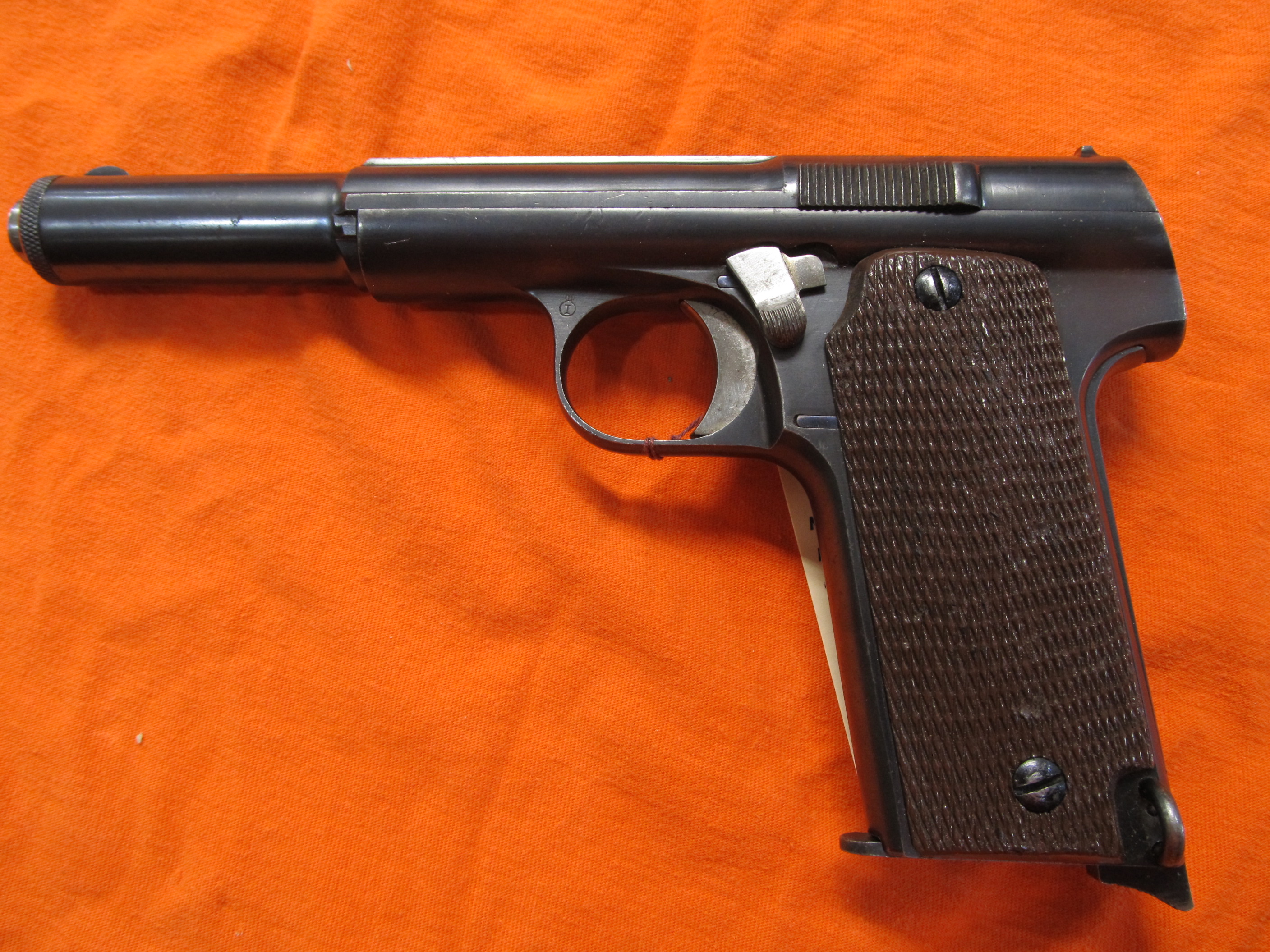
Among the smallest of the autoloaders is the Firestar by Star, a Spanish company. This gun is not much bigger than the average .380 ACP pocket gun, but is chambered for the much more powerful 9 mm, and also in .45 Auto. Superior metallurgy and advanced engineering have enabled the maker to scale it down, yet retain full-power ammunition. The Firestar has a lot of advanced features, and has been a major success. It sells for about $450.
Now, I have to be honest and admit that I am prejudiced against Spanish guns. I have owned four Spanish products, and they were all dogs. Personally, I wouldn't take a Llama as a gift, unless it was the kind that eats grass. I'm not really impressed with Stars, either, though several people who I know and respect as savvy shooters own the Firestar and like it very much.
Combat Tupperware: The "Plastic Guns"
The Glock, an innovative polymer-framed double-action pistol
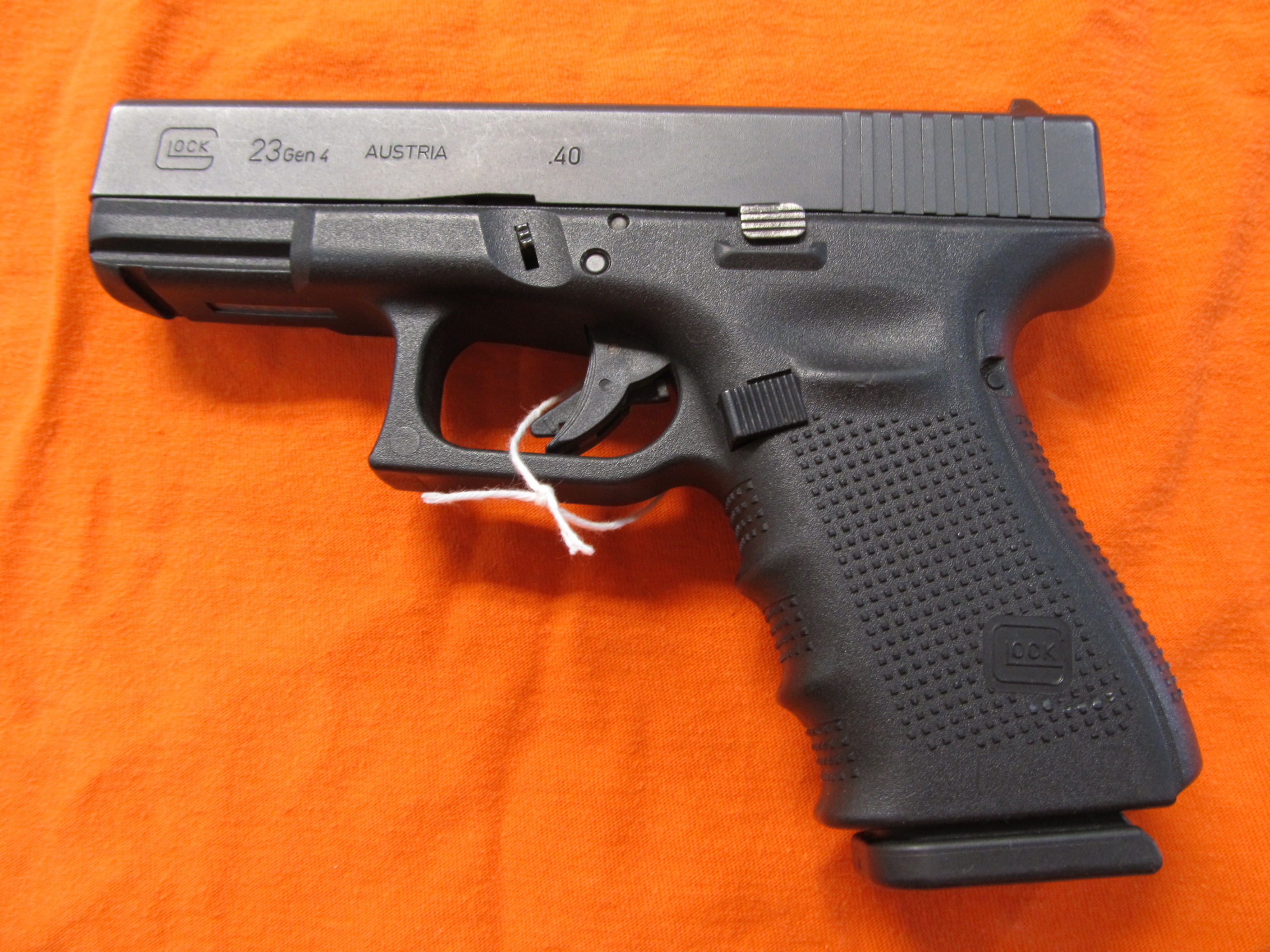
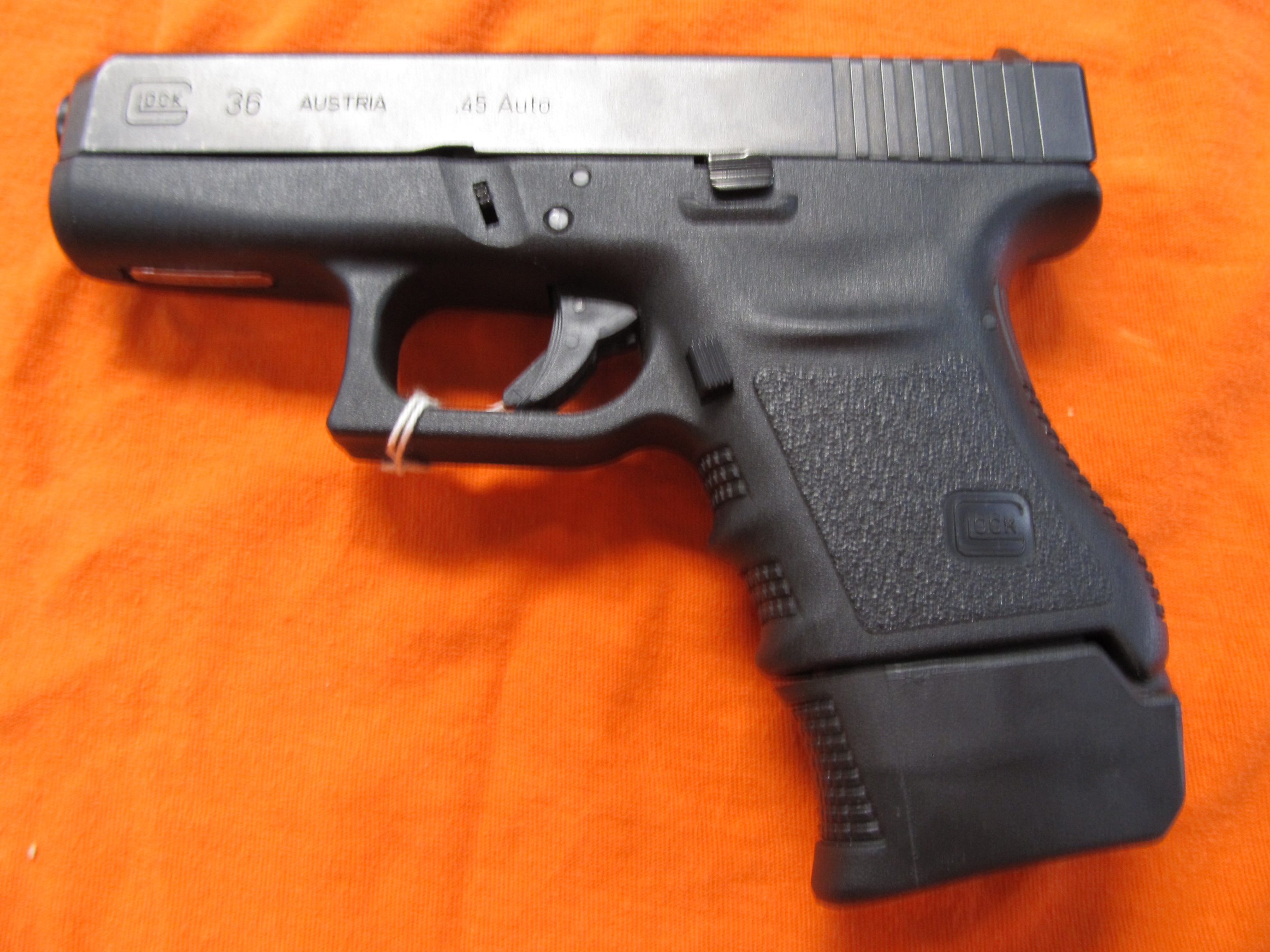
Glock is an Austrian company making a series of pistols that have taken the American commercial and police markets by storm, much to Ruger's and S&W's dismay. There are two Glocks in 9 mm, the Model 17 (17 shots) and the Model 19 (15 shots). They also make the same gun in .45 ACP as the Model 21. These high-tech "Wonder-nines" have injected polymer frames, rather than steel. It's said to be easy to shoot and very accurate. Glocks are in the $580-650 range. Glock has also moved into the small-gun market, with their Model 26, a very compact 9mm.
I have shot the Model 19 a bit, a friend has one. It's a little weird to my way of thinking (anyone who was trained on a 1911-A1 has trouble with this type of pistol) but the one I used was light, and amazingly accurate. If his gun is a fair sample, the Glock also meets the criterion for reliability: he told me he's put 3000 rounds through it without having even a single jam. That's about as reliable as a gun can get. I'm a dyed-in-the-wool, hard-shelled old mossback, but recently I've moderated my suspicion, and I'd have no hesitation about carrying a Glock anymore. Glock also makes versions of all its guns in .40 caliber.
Incidentally, the Glock design was the subject of a lot of deliberate lies in the press some years ago as a "...plastic gun designed for terrorists to get through airport checkpoints." This is sheer baloney, and the Glock, the "terrorist" weapon that caused serious hyperventilation at the Washington Post, is now used by the DC police force, among many others.
Two Smith and Wesson polymer-framed pistols: the Sigma .380 (left) and the Compact 9
Smith & Wesson have paid Glock the ultimate compliment of imitation, recently having introduced near-copies of the 19 and a couple of smaller versions, too. The S&W Sigma is their polymer-framed .380 for this market, and they've also introduced a compact 9mm.
An Oldie But A Goodie
As I said, I much prefer single-action autoloaders to double action ones. But if I had to choose a DA autoloader I'd probably pick an older S&W gun, the Model 39. This "first-generation" DA is no longer made, but used ones (mostly police surplus) are becoming generally available. The 39 is the ancestor of S&W's current autoloaders, and I find it more congenial than the more recent models.
Autoloaders That Got Hit By The Ugly Stick
Bill Ruger's Boxcar: the P-89 double-action autoloader
To someone used to Colt products, it's obvious that Ruger's designers weren't much concerned with looks when they brought out their current line of auto loading pistols. The Ruger P89 and its bigger brother, the P90, have all the lithe grace and sleek lines of a railroad boxcar. For all their dyed-in-the-bone homeliness, however, the Ruger products are accurate and dependable.
The Ruger P89 in 9 mm is one of the most popular of the current production DA autoloaders, and it has a big price advantage over the competition. The P89 sells locally for something under $400. The P90 is the same gun in .45 caliber, and compact versions are also available. These also are affected by the magazine ban, but Ruger is allegedly shipping guns with Politically Correct, Administration-Approved, Non-Baby-Killing 10-round magazines. Of course, the old evil ones will still work if you find them.
Smith & Wesson's Offerings
In addition to their polymer-framed guns, S&W makes some very nice autoloaders. The Model 908 and the Model 3913 are especially suited to women as carry and home defense guns.
Two S&W double-action-only autoloaders: the 908 (left) and the 3913. These models have "bobbed" hammers and can't be cocked with the thumb
These guns have a lot of features that appeal to women, including double action capacity, and a magazine safety. The gun will not fire if the magazine is removed. Some people don't care for this feature, but it does makes sense, especially if there is a child in the house. Should Mom forget her training and not follow the standard procedure of clearing the magazine and the chamber, the gun can't be fired by a curious child (unless Mom has stupidly left the magazine nearby, and Junior is smart enough to insert it.) These two guns are also fairly compact and pretty easily hidden. I think all in all they are about as good a choice for a one-gun woman as could be found. You can usually get these guns new for around $400-450.
No Bull
Taurus is hotly competitive in the small-gun market, and they make an inexpensive and very nice and easily concealed compact 9mm, the Model PT902. In keeping with current practice this is a double-action, and it's small enough that most women will have no trouble getting a decent grip and controlling it in rapid fire. It's also less expensive than a Beretta or S&W would be. I haven't personally used one of these yet, but it looks like a very viable option to the mid-sized S&W's or larger-frame guns.
SOME SPECIFIC MODELS:
II: Revolvers
Smith and Wesson is this country's premier handgun maker, with a wider variety of revolvers available than anyone else. The list prices for new S&W revolvers are about $100-150 higher than for a comparable Rossi or Taurus. While fit and finish are better, it's debatable whether the extra money buys you a gun that's overall a really superior product; the Brazilian guns are very good. Resale value of a Smith and Wesson will be high, and a used S&W may be priced in the same range as a new Rossi or Taurus.
The S&W Snubbies
Of the S&W snubs, the Model 60 and the Model 36 are 5-shooters. The Model 36 is blued steel, the Model 60 is the same gun in stainless. S&W also makes a concealed-hammer, double-action only J-frame revolver. The Model 60 is probably the world's most popular pocket gun, and rightly so; it's a real compact powerhouse in J-frame size. The 640-1 is a .357 Magnum-chambered J-frame.
S&W's pocket revolvers: the stainless steel Model 60 (left) and the concealed-hammer Model 640. Blued versions and "Airweight" aluminum-framed versions are also available.
S&W make "Airweight" aluminum-framed versions of the Model 36 and the Model 37. These guns weigh only about 13 ounces, and can be carried comfortably for many hours. While some of the steel S&W snubs can be shot with +P ammunition, not so the Airweights, which are severely, stressed this way. In addition, the use of even standard ammunition in an Airweight causes a substantial level of recoil, and the +P would be much worse. I have fired an Airweight with standard .38's and I'll take a .44 Special any time...if I am going to subject my hand to that much pounding, and have only five shots, I'd like to get a little more for it than a .38 will produce.
As Usual, I Have Other Ideas
As nice as the J-frame Smiths are, I actually prefer the medium-frame Model 10, which can be obtained with a 2" barrel and round grips. It's larger, but has one more shot; it can be effectively hidden; and it will accept +P ammunition without problems.
The Model 10, or "Military and Police" revolver. This gun has been used by police agencies all over the world, and used examples in excellent condition can be found for well under $200
The Model 10 has been in pretty much continuous production since 1905, and is the most successful double-action revolver ever produced. It has been the mainstay of more police departments than any other model. The stainless steel version of the Model 10 is the Model 64 New S&W's aren't cheap: typical list prices are in the range of $350-450.
Revolvers That At Least Got Tapped With The Ugly Stick
Ruger double-action revolvers are not so ugly as their autoloaders, but they are close. They lack the graceful lines of the Colts and S&W's; but they are unquestionably first-quality firearms. Their small revolver is the SP101. It's chambered in .357/.38 Special and has earned high praise in the gun press for reliability and ease of use. My brother carries one of these, and I can testify that a 2-1/2" barreled SP-101 is--ahem, er, uh--exciting to shoot, to say the least. The fireball it throws out with full-power .357 Magnum amm